


About
This is your About Page. It's a great opportunity to give a full background on who you are, what you do and what your website has to offer. Double click on the text box to start editing your content and make sure to add all the relevant details you want to share with site visitors.


Mission
This is your About Page. It's a great opportunity to give a full background on who you are, what you do and what your website has to offer. Double click on the text box to start editing your content and make sure to add all the relevant details you want to share with site visitors.

Vision
This is a Paragraph. Click on "Edit Text" or double click on the text box to start editing the content and make sure to add any relevant details or information that you want to share with your visitors.

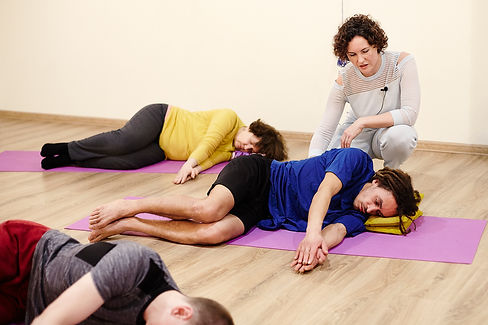
I work with individuals and groups, integrating Hanna Somatics, the Feldenkrais Method, and trauma-informed bodywork to support nervous system regulation and enhance movement awareness.
I firmly believe that through mindful movement and deep body awareness, we can strengthen resilience, relieve chronic tension, and unlock our full potential.
I look forward to connecting and exchanging knowledge in the field of somatic practices and embodied well-being!
Somatics for me is a way to stay alive.
When I look around, I see how disconnected people are from their bodily experiences, how they spend most of their lives "in their heads," often unaware that they can pay attention to their bodies, not just when something hurts.
This simple idea forms the foundation of somatic learning: you can return your attention to your body and start to become aware of what is happening within. It's incredible, but people visibly become happier. I witness this every day.
When a slouched person with a dull gaze leaves the room with eyes sparkling, with desires, with a dancing walk, as if they've shed decades from their shoulders, it's truly remarkable.
What's even more surprising is that people become kinder to themselves. They start to feel how they themselves tense their shoulders, tighten their hips, how they hold themselves back from moving, how they freeze and hold their breath.
When a person starts to realize what they are actually doing, they gain the power of choice.
My diploma and professional education:
Feldenkrais Method - 4-year training (Elisabet
Bloom Approach)
Somatic Experiencing® - entry level (SETM
International)
Certified Somatic Educator (The Ingle
Institute for Somatic Education)
Mission
This is your About Page. It's a great opportunity to give a full background on who you are, what you do and what your website has to offer. Double click on the text box to start editing your content and make sure to add all the relevant details you want to share with site visitors.
I'm a paragraph. Click here to add your own text and edit me. It's easy.
Vision
This is a Paragraph. Click on "Edit Text" or double click on the text box to start editing the content and make sure to add any relevant details or information that you want to share with your visitors.

Somatics Is Not Fitness — It’s a Way Back to Yourself

There’s a simple, yet often uncomfortable truth: to see real results, you need to practice regularly.
Just like brushing your teeth or getting enough sleep. Once a month is better than nothing, of course — but for lasting change, you need to return to the practice again and again.
I often hear from new participants:
“It felt like we barely moved, but my posture improved!”
“I hardly moved, yet my back pain went away.”
The secret isn’t in the intensity — it’s in the quality of attention. In how you move and the connection you build with your body. And most of all — in consistency.
Somatics isn’t about strength or endurance. It’s not about pushing limits or achieving goals.
It’s about restoring connection with your body. About gentle, mindful movement. About coming back to the feeling: “I’m at home, in my body, and it feels good.”
That’s why it’s especially helpful for:
-
People recovering from injuries or surgeries, for whom fitness or even yoga is too intense
-
Those who don’t enjoy or can’t go to the gym due to pain, fatigue, or self-consciousness
-
Anyone living with high stress or anxiety — somatic practice gently regulates the nervous system
-
People who want to care for themselves differently: not through “musts” and strict schedules, but through curiosity, attention, and exploration
What Makes Somatics Different From Other Body Practices?
-
It’s not a workout — it’s an exploration. There’s no goal to "sculpt your abs" or "improve your flexibility." You’re not working toward a result — you’re building awareness. And paradoxically, that’s when results start to appear.
-
It’s not about doing — it’s about feeling. Sensation matters more than the correctness of the shape. Making mistakes isn’t bad — it’s a resource for learning.
-
No suffering required. There’s no pushing through pain, no “just one more rep,” no “you have to endure.” You’re allowed to stop, shift, or change your mind. Respect for your body comes first.
-
No judgment. Somatics isn’t about “better or worse,” “flexible or stiff.” It’s about “this is what I feel now” — and how that might shift.
Because the nervous system learns through repetition. If once a week you come back to gentle movement, notice your breath, pay attention to how your neck or pelvis feels — your brain starts building a new body map. And with it, new possibilities emerge.
Chronic tension begins to melt.
Lightness appears.
Breathing deepens.
Posture becomes more natural.
Sleep improves.
Your mood stabilizes.
I recommend practicing for 1–2 hours a week. And if you can, just 10 minutes a day — tuning into your body: breathing, noticing the support of the ground, doing a movement or two with care.
This doesn’t take strict discipline. Just attention and gentleness.
The effects accumulate.
After a couple of months, you might suddenly notice you feel completely different — calmer, freer, more confident. If this speaks to you — come try one of my sessions. They’re designed for those who want to return to the body with care and without pressure or shame. With curiosity, gentleness, and the kind of consistency that supports — not overwhelms.
Ready to begin? Register for online sessions now — with care, presence, and no pressure.
